
Patient Voices Needed to Shape Gene Therapy for SDS — Two Opportunities to Make It Count

Welcome to SDS Spotlight — our monthly series where Eszter shares a quick update on what we're working on, what we're excited about, and how YOU can get involved. Each month features a short video and a deeper dive right here on the blog.
Gene therapy for SDS is advancing. Early lab studies are promising. The tools — base editing and prime editing — are already being tested for other blood disorders, in real people. For SDS, researchers have shown they work in early lab studies. No clinical trial yet — but we are closer than ever.
And this is the moment when your voice can make the biggest difference.
Why Patient Perspectives Matter — and Why Now
When researchers consider and plan gene therapy trials for rare disorders such as Shwachman-Diamond Syndrome (SDS), they must make dozens of decisions that go far beyond science alone. Who should be eligible? Should a therapy be offered preventively — before complications develop — or only when the situation becomes more urgent? How do patients and families weigh the risks of an experimental therapy against the risks of waiting? What would make a patient or family say yes, and what would make them say no?
You can't find the answer to these questions in a lab or medical records. Only people who live with SDS every day can provide the answers. And for a rare disease like SDS — where the patient population is small and every voice counts — structured, systematic input from the community is essential.
Patient perspectives are used in all key aspects of research in therapy development:
The FDA uses patient input to inform benefit-risk assessments when reviewing new therapies.
Drug developers use it to design clinical trials, select meaningful endpoints (decide what to measure), and understand what the patient population actually needs.
Researchers cite it in grant applications, funding requests, and regulatory applications to demonstrate that their work is grounded in patient-identified priorities.
The time to share your perspective is now, during the trial planning stage, when the answers can still influence who is included, what outcomes are measured, and how the therapy is delivered. Once a trial is underway, it is much harder to change course.
Opportunity 1: The SDS-GPS Gene Therapy Perspectives Survey
SDS Alliance has launched a gene therapy perspectives survey on SDS-GPS — our IRB-approved, safe and secure global patient survey program.
The survey asks about your priorities, your concerns, and your perspectives on three approaches being studied for SDS. It takes about 45 minutes and covers questions researchers and regulators actually need answered — including how families think about preventive versus reactive approaches, what risks feel acceptable, and what it would actually take to say yes to participating in a clinical trial.
Your responses will go to researchers working on SDS gene therapy and help shape trial design.
The survey is live now. Once you log in to SDS-GPS, it will pop up automatically, or you can find it on your dashboard under surveys. You may have also received an automatic email about it.
If you are not yet on SDS-GPS, setting up your account is free and takes about 30–60 minutes to fill out the baseline surveys. You can take breaks anytime. If available, upload your genetic testing report along the way, or later if you prefer.
Not Sure Where to Start? Explore the Interactive Guide First
If you would like to understand the gene therapy landscape before taking the survey, our free interactive guide walks you through the three approaches being studied for SDS — in plain language, with animations and visuals, at your own pace. No scientific background needed.

The guide and the survey are designed to work together. The scenarios and concepts in the survey match those explained in the guide. Exploring the guide can help you be more familiar with the terms and concepts mentioned in the survey, but it's not required.
If you want to dive even deeper, read the July blog post on gene therapy for SDS, which includes a video on the basics of SDS genetics and an expert introduction to gene and prime editing.
Opportunity 2: The GeneTX Study at St. Jude Children's Research Hospital
SDS Alliance is supporting recruitment for GeneTX — an IRB-approved research study led by the Bioethics Program at St. Jude Children's Research Hospital. The study aims to understand what gene therapy information and support people with Shwachman-Diamond Syndrome and their families need most.
Participation involves a 45–60 minute tele-interview. Participants age 18 or older may participate independently. Participants ages 8–17 participate with a caregiver present.
All participants receive $100.
Who may be eligible:
A person age 8 or older with SDS, or a caregiver of a person with SDS
The person with SDS has never been offered gene therapy (true for the whole SDS community at this time)
International families are welcome.
Participation is voluntary and does not obligate you to anything further.
To learn more or express interest, contact the GeneTX study team at genetxstudy@stjude.org.
SDS Alliance can also make an introduction — reach out to Eszter at ehars@sdsalliance.org.

All September Resources at a Glance
Gene therapy perspectives survey: Log in to SDS-GPS — survey appears automatically
Set up an SDS-GPS account: www.sdsalliance.org/sds-gps-join
Interactive gene therapy guide: www.sdsalliance.org/gene-editing-explainer
GeneTX study: genetxstudy@stjude.org
More about SDS-GPS: www.sdsalliance.org/sds-gps
Questions? Contact us anytime at connect@sdsalliance.org
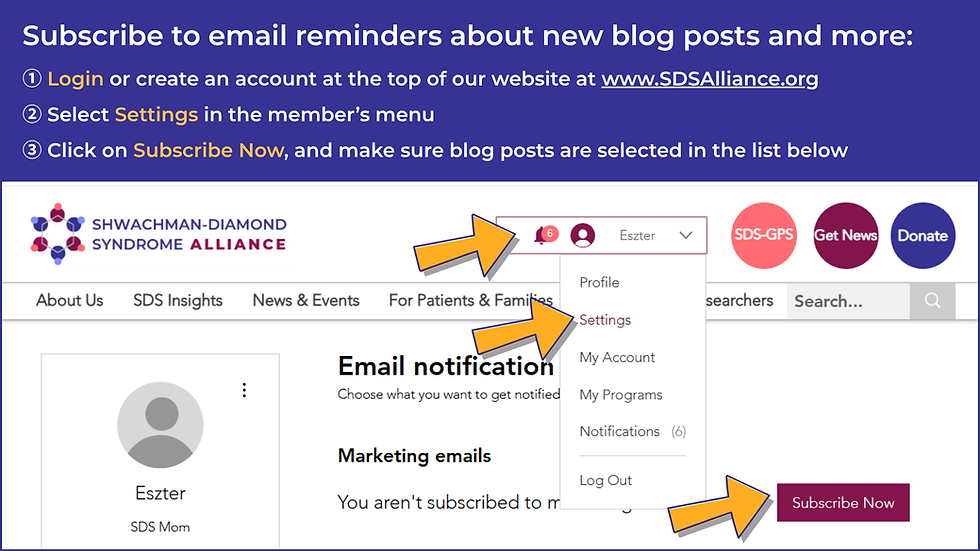
Subscribe to our blog to get email reminders about new posts!
① Login or create an account at the top of this website
② Select Settings in the member’s menu
③ Click on Subscribe Now, and make sure blog posts are selected in the list below


Comments