
How YOU can help move gene therapy forward for SDS

Welcome to SDS Spotlight — our monthly series where Eszter shares a quick update on what we're working on, what we're excited about, and how YOU can get involved. Each month features a short video and a deeper dive right here on the blog.
In this month’s SDS Spotlight, Eszter Hars, Ph.D. — molecular biologist, SDS Alliance CEO, and mother of a child with SDS — shares a brand new tool we developed for patients and families to learn about gene therapy for SDS, and how their voice can help move it forward. One step closer to Clinical Trials by 2030.
How you can help move gene therapy forward for SDS
Gene therapy for SDS is getting closer to reality. Research has reached a stage where your perspectives — what you hope for, what you worry about, and what you need to know — can shape what gets developed and how. This is your invitation to be part of this work.
What patients and families told us they want to know
A few weeks ago, we ran a quick poll in our Family Network Facebook group.
We asked: What would you most want to learn about gene therapy for SDS?

Nearly 40% of you wanted to know when it will be available.
Another 27% wanted to know who would qualify.
There was less interest in how it works and what the risks are.
The key questions from the patient and family community: When and for whom.
These are hard questions to answer. We don't know yet. What we do know is that the timeline depends, in part, on how well prepared the community is when trials open. And that preparation starts now.
Why gene editing? Why for SDS specifically?
Let's look into what makes gene editing the right approach for SDS, and why it took until now to get here.
If you have watched our genetics video, you already know that SDS is caused by a spelling mistake in the instruction book that tells your body how to build and run itself. One specific spelling mistake — called the splice-site mutation, or c.258+2T>C — is present in virtually all patients whose SDS is caused by changes in the SBDS gene. Because almost everyone shares this same change, researchers can focus their entire effort on correcting that one typo. That is unusual in rare diseases, and helps us tremendously in moving development forward.
Are you new to the genetics of SDS? Our short video explains the basics:
But correcting a spelling mistake in a living cell, and enough of them, is not easy. Until recently, gene therapy approaches were not efficient or precise enough. Traditional gene therapy approaches added extra copies of a gene in multiple spots in the genome, which doesn't work for SDS either, because the body needs exactly the right amount of SBDS protein. Not too much, not too little. More recent CRISPR tools worked with more precision, but they cut both strands of DNA in ways that blood stem cells don't handle well.
This is where the newer generation of gene editing tools comes in. Base editing and prime editing — developed by Dr. David Liu at the Broad Institute or MIT and Harvard — can find and fix a single letter in a three-billion-letter instruction manual without cutting both strands of DNA. They make smaller, more controlled changes that blood stem cells tolerate far better. And they correct the spelling mistake in its original location, which is essential for preserving the body's natural control over how much SBDS protein is made.
Here is Dr. Liu explaining how these tools work, in his own words:
These tools are now ready for patients. Clinical trials using these approaches are already underway for other blood disorders (not yet SDS), with early results promising and laying the groundwork for additional genetic disorders. For SDS specifically, researchers have shown these tools work in early lab studies. No clinical trials yet — but we are getting closer.
We make learning about gene therapy for SDS easy for you

Gene therapy is a complex topic. We get it. That is why we built an interactive guide specifically for SDS patients and families. No scientific background needed.
The guide walks you through what gene therapy for SDS would actually look like, the three approaches being studied, who they are designed for, and what is still unknown. If you want to go deeper into the science, that option is there too, but it is completely optional.
There are animations, visuals, and plain-language explanations at every step. You can go at your own pace, come back anytime, and share it with anyone in your life who wants to understand what is happening in SDS research.
This is the conversation the SDS community deserves to have.
Start here.
What we still need to learn — and why your voice matters
Here is what the science and lab research cannot tell us:
What matters most to you.
Researchers can design a therapy that works in a lab. They can show that it is safe in animal models. They can run a Phase 1 trial to establish safety in humans. But they cannot design a trial that works for our patients without knowing what they actually want and need.
Do families want a preventive approach — something that could reduce future leukemia risk before the disease progresses — even if it means being among the first to try it?
Or do they want to wait until their situation becomes more urgent?
How do families think about chemotherapy as part of the process?
What would it take for a family to say yes to an experimental therapy?
What would make them say no?
Researchers, therapy developers, and regulators (such as the FDA) need to hear from you. They cannot get this information from anywhere else but YOU. And the time to share your voice is now, before trials open, when the answers can still influence how trials are designed, who is included, and what outcomes are measured.
That is exactly what we are building toward.
What you can do right now
This fall, SDS Alliance is launching a gene therapy survey on our patient survey and registry platform, SDS-GPS. It will ask you about your priorities, your concerns, and your perspectives on three different approaches being considered for SDS. Your responses will inform researchers and help shape how gene therapy is developed for SDS patients.
The survey opens in September. But you can get ready now.
We have built an interactive educational tool to help you understand the landscape before the survey opens. It includes the three approaches being studied, who they are designed for, and what we still don't know. The science behind gene editing for SDS is also explained, but it's optional. The tool is designed for patients and families, not scientists. No prior knowledge needed.
And if you are not yet on SDS-GPS, now is a great time to set up your account. Onboarding takes about 30–60 minutes, and once you are set up the survey will be waiting for you in September.
A note on timing
We know the question families most want answered is "when". We cannot give you a an exact date. What we can tell you is that the science is advancing, the tools exist, and the SDS community is making progress. Clinical trials for other blood disorders are generating data that will pave the path for SDS. And you sharing your voice now is a critical piece of the puzzle.
The question is no longer if. It is when — and how well-prepared we are when the moment arrives.
Your perspective is part of that work. Join us.
Questions about this survey or SDS-GPS? Contact us at gps@sdsalliance.org
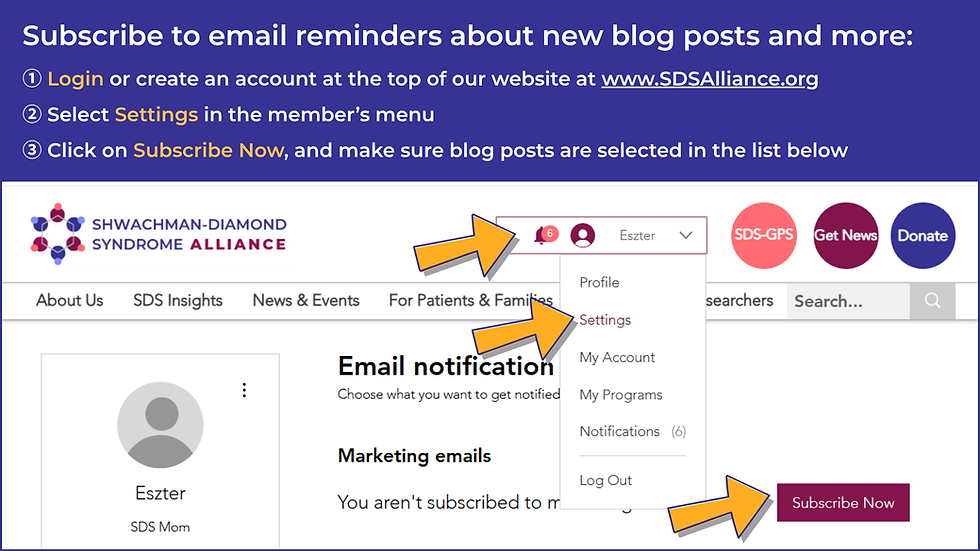
Subscribe to our blog to get email reminders about new posts!
① Login or create an account at the top of this website
② Select Settings in the member’s menu
③ Click on Subscribe Now, and make sure blog posts are selected in the list below


Comments