
One Year Later: The SDS PFDD Voice of the Patient Report Is Published — and Your Voice Is Already at Work

One year ago, on June 4th, 2025, the SDS community gathered in Cincinnati — and online from around the world — for the Shwachman-Diamond Syndrome Externally-Led Patient-Focused Drug Development (EL-PFDD) meeting. Patients and parents spoke from a podium, sat in an audience, and raised their hands. Young adults described what it felt like to grow up with an invisible disease. A documentary film premiered. And for one full day, the people who live with SDS — or love someone who does — told the research and regulatory community exactly what it means.
Today, on the one-year anniversary of that impactful meeting, SDS Alliance is proud to share that the official Voice of the Patient (VoP) report for Shwachman-Diamond Syndrome has been published, submitted to the FDA, and made available to the world. Your voice is now a document. A citable, permanent, freely available document — and it is already at work.
In this month's SDS Spotlight, Eszter Hars, PhD, marks the one-year anniversary of the SDS EL-PFDD meeting and shares what came of it — including the publication of the Voice of the Patient report. Watch the video below, then read on for the full story.
What Is a Voice of the Patient Report?
The Voice of the Patient report is the official output of an Externally-Led Patient-Focused Drug Development (EL-PFDD) meeting — a type of meeting structured by the FDA to systematically capture the patient perspective on a specific disease. The FDA's Patient-Focused Drug Development initiative was established because patients and caregivers have knowledge that clinical data alone cannot capture: what it actually feels like to live with a disease, which symptoms matter most, what trade-offs families are willing to accept, and what a meaningful improvement in daily life would actually look like.
For Shwachman-Diamond Syndrome (SDS) — a rare disease that affects an estimated 2,000–3,000 people in the United States — this kind of document has never existed before. Until now.
What the Report Captures
The report documents the input of patients and caregivers who participated in the June 4th, 2025 EL-PFDD meeting through prepared panel statements, moderated audience discussion, live polling, written comments, and a community survey.
We also capture a brief video memory of the meeting itself. Wacth it below.
The full report was prepared by Eszter Hars, Ph.D. of SDS Alliance in collaboration with Vanessa Merker, Ph.D. of Massachusetts General Hospital and Harvard Medical School, with guidance from FDA and legal and regulatory experts at Hyman, Phelps & McNamara.
The report is organized around two core topics that defined the meeting.
Topic 1: Living with SDS — Symptoms and Daily Impacts
Patients and caregivers described SDS as a multisystem, lifelong disease with profound physical, emotional, and social consequences — not only for the person diagnosed, but for their entire family. Chronic infections disrupt schooling and careers. Feeding difficulties and poor growth shape children's earliest years. Skeletal complications may limit mobility and require multiple surgeries. Cognitive and neurodevelopmental issues cause challenges in school and work. And all of it is often invisible — leaving families to constantly explain a disease that others cannot see.
Above all, the fear of leukemia dominates. It shapes where families travel, what activities are possible, and how every treatment decision is made. As Cresta, an adult living with SDS, described:
It causes me anxiety to wait weeks for the results and wonder if it will be positive or negative, and will I be facing death soon.
In the live polling, the stress of not knowing if or when leukemia might develop was tied for the top worry about the future — selected by nearly every respondent.
As Nicole, mother of ten-year-old Roman, captured:
SDS doesn't just steal health — it robs childhoods, careers, and stability."
Topic 2: Patient Perspectives on Current Treatments and Future Therapies
Current treatments — hematopoietic stem cell transplant (HSCT), G-CSF, pancreatic enzyme replacement therapy, and supportive care — have extended and improved lives. Patients and families are deeply grateful for them. But none addresses the underlying cause of SDS, many carry high physical and emotional costs, and many symptoms have no treatment at all.
The community's priorities for future therapies were consistent and clear: reduce the risk of leukemia; provide alternatives to transplant or make it safer; develop treatments that patients can actually tolerate; improve growth and reduce skeletal complications; and reduce the burden of ongoing surveillance. When patients and families say they want treatments that are safe, they mean above all else treatments that do not increase the risk of leukemia.
A longtime community member captured both the exhaustion and the determination that defined the day:
I hate transplants. I hate Neupogen. I hate it all. But there is progress. Keep pushing.
Why This Report Matters — and How It Will Be Used
Voice of the Patient reports are a formal tool in the FDA's drug review process. The FDA uses them to inform benefit-risk assessments when reviewing new therapies, to understand what outcomes matter most to patients, and to provide context that clinical trial data alone cannot. Drug developers use them to design clinical trials, select meaningful endpoints, and understand the patient population they are developing therapies for. Researchers cite them in grant applications to demonstrate that their work is grounded in patient-identified priorities. For a rare disease like SDS — where the patient population is small and the research infrastructure is still developing — a well-documented VoP report carries particular weight.
This report has a permanent DOI (https://doi.org/10.5281/zenodo.20126868) and is published under a Creative Commons Attribution 4.0 license, meaning it can be freely cited, shared, and adapted with appropriate attribution. It is also submitted to the FDA docket. Any researcher, drug developer, or regulatory reviewer working on SDS can read exactly what the SDS patient and caregiver community said — in their own words — about what matters most and what is at stake.
As Joyce, a high school student living with SDS, described her experience:
A kid like me shouldn't have to determine their dream university based on whether there is a medical professional within 100 miles who is even aware of their condition.
This and many other heartfelt insights are now in a citable document.
What You Made Possible
This report came to life because of the nearly a hundred people who showed up on June 4th, 2025 — in Cincinnati, online, in the survey, in the written comments, and in the documentary film that premiered that day. Every person who shared their story, answered a poll question, or sat in the audience contributed to a document that will guide the teams developing treatments for SDS.
The report was prepared and submitted on behalf of SDS Alliance by Eszter Hars, Ph.D., in collaboration with Vanessa Merker, Ph.D. (Massachusetts General Hospital and Harvard Medical School). Major funding for the EL-PFDD meeting was provided by the Chan Zuckerberg Initiative (Rare As One program) — now Bi[o]hub — and PCORI as part of a Eugene Washington PCORI Engagement Award (EASO-42419).
To cite the report, we suggest: Hars E, Merker V. (2026). Voice of the Patient Report for Shwachman-Diamond Syndrome. SDS Alliance. https://doi.org/10.5281/zenodo.20126868
What Comes Next: Continuing to Build With Your Voice through Project PACER
Publishing the VoP report is one piece of a larger effort to ensure that the SDS patient perspective is embedded in every conversation about this disease — in research, in clinical care, and in the resources that help families navigate a diagnosis.
This month, SDS Alliance is launching story recruitment for the PACER manual — Living with Shwachman-Diamond Syndrome: A Practical Guide. This is a comprehensive resource being developed with clinical experts from around the world, with patient and family stories at the center of every chapter. The first thing a reader will see in each chapter is not a clinical summary, but a real person describing a real-life experience with SDS.
Over the coming months, we will be inviting stories on different topics — physical symptoms, daily life, mental health, research participation, and more. Watch for more details, and visit www.sdsalliance.org/pacer#patients to learn how to get involved.
We are also recruiting clinical and research experts to contribute chapter overviews. If you are a clinician or researcher interested in contributing, visit www.sdsalliance.org/pacer#professionals for details.
Read the Report
The full Voice of the Patient Report for Shwachman-Diamond Syndrome — including the executive summary, full topic summaries, live polling results, and appendix — is available at:
For questions about the report or to request permission to adapt or use it, contact patientvoice@sdsalliance.org.
SDS Alliance is a US-based 501(c)(3) nonprofit organization serving the global SDS community. Our mission is to improve and save the lives of people affected by SDS by accelerating research and therapy development. Learn more at www.sdsalliance.org.
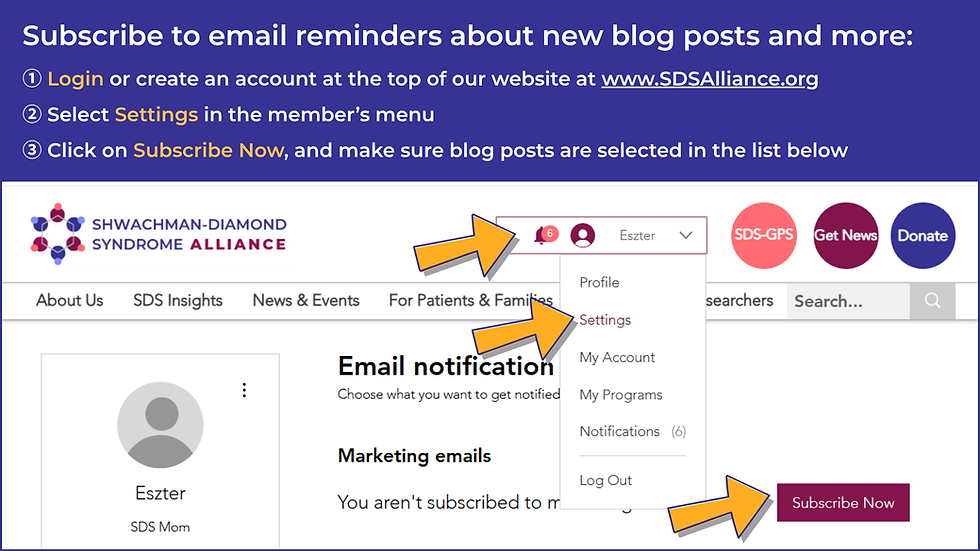
Subscribe to get email reminders about new blog posts and more:
① Login or create an account at the top of this website ② Select Settings in the member’s menu ③ Click on Subscribe Now, and make sure blog posts are selected in the list below


Comments