
New Resources for School Success with Shwachman-Diamond Syndrome — and How You Can Help Build More

Welcome to SDS Spotlight — our monthly series where Eszter shares a quick update on what we're working on, what we're excited about, and how YOU can get involved. Each month features a short video and a deeper dive right here on the blog.
Every August, families navigating Shwachman-Diamond Syndrome (SDS) face a familiar challenge: a new school year brings with it a new set of teachers, counselors, and administrators who have likely never heard of SDS. How do you help them understand — quickly, clearly, and in a way that also shows them who your child really is?
This month, SDS Alliance is launching two new free resources to help. Both were built with and for the SDS community, and both are available now.
A Personalized School Letter — Built from a Community Idea
The SDS School Letter Tool was inspired by Angela, a mom in the SDS community who had already solved this problem for her own son years ago. She created a trifold she could hand to his school team — something personal, portable, and practical. That idea stuck.
SDS Alliance built it into a tool that any patient or family can use.
Here is how it works: you answer a few questions about the patient, select relevant accommodations from a curated list, add one or more photos, and a few details about their personality and hobbies. The tool generates a personalized, ready-to-share document — either a multi-page letter or a double-sided trifold layout — as a downloadable PDF.
The letter introduces the whole person, not just the diagnosis. Teachers and school staff get the medical context they need alongside a sense of who this student actually is.
The tool is published on Zenodo under an open license — if you work with another rare disease community and would like to adapt it, the files are freely available.
Suggested citation: Hars E. (2026). SDS School Letter Tool. SDS Alliance. https://doi.org/10.5281/zenodo.21324915
A Comprehensive School Guide for Patients, Families, and School Teams
For families and care teams who want to go deeper, SDS Alliance has also published a comprehensive school guide: Supporting Students with Shwachman-Diamond Syndrome: A Guide for Patients, Families, and School Teams.
The guide covers:
How SDS affects learning, attendance, and daily school life
Navigating IEPs, 504 plans, and other formal accommodations
Communicating effectively with teachers, nurses, and administrators
Managing SDS-related challenges at school — neutropenia, fatigue, pain, cognitive differences, and more
Transitioning from pediatric to adult care, and from school to college or work
Supporting adult patients navigating workplace accommodations
The guide was developed as part of Project PACER — SDS Alliance's PCORI-funded initiative to build comprehensive, community-informed resources for the SDS community. It was clinically reviewed by Dr. Thea L. Quinton, pediatric neuropsychologist at Cincinnati Children's Hospital, and her colleagues who work directly with school teams.
It is written for three audiences: patients, families, and school professionals, so that a teacher can pick it up and understand SDS in the context of their classroom, while a parent can use the same document to prepare for an IEP meeting.
The guide is free, open-access, and published on Zenodo with a permanent DOI — meaning it is citable, shareable, and will remain available long-term.
Suggested citation: Hars E. (2026). Supporting Students with Shwachman-Diamond Syndrome: A Guide for Patients, Families, and School Teams. SDS Alliance. https://doi.org/10.5281/zenodo.21316992
How These Resources Came to Be
Both resources were developed as part of Project PACER — SDS Alliance's initiative to build the infrastructure of knowledge and community engagement that rare disease research depends on. Funded by PCORI (Eugene Washington PCORI Engagement Award EASO-42419), PACER is creating a suite of resources that center the patient voice at every step.
The school letter tool and guide reflect our belief that the best resources for the SDS community come from the community itself. Angela's trifold served as the inspiration. Dr. Quinton's clinical expertise gave the guide professional depth. The families who reviewed it and provided feedback made it come to life.
This is how our community works — solving problems together and sharing the solutions with everyone who comes after.
What Comes Next — and How You Can Help
The Essential Guide — Living with Shwachman-Diamond Syndrome: The Essential Guide for and by Patients, Families, Clinicians, and Researchers — is the larger resource Project PACER is building. It will cover every major aspect of SDS across 29 chapters, with clinical expert overviews, research updates, and patient and family stories at the center of each one.
School, work, and daily life accommodations is one of those chapters. But there are many more. We are currently collecting patient and family stories across a wide range of topics — from neutropenia and bone marrow monitoring, to dental health, cognitive development, emotional wellbeing, transplant experiences, and more.
You do not need to be a writer. You do not need a dramatic story. You just need a relevant lived experience and a willingness to share it, on your own terms.
If something resonates, reach out to Eszter directly at pacer@sdsalliance.org. We will figure out together whether your story is the right fit.
All August Resources at a Glance
School letter tool: www.sdsalliance.org/school-letter
School guide: www.sdsalliance.org/school-guide DOI: https://doi.org/10.5281/zenodo.21316992
All SDS Alliance guides: www.sdsalliance.org/guides
Share your story for the upcoming Essential Guide: www.sdsalliance.org/pacer-story
Project PACER: www.sdsalliance.org/pacer
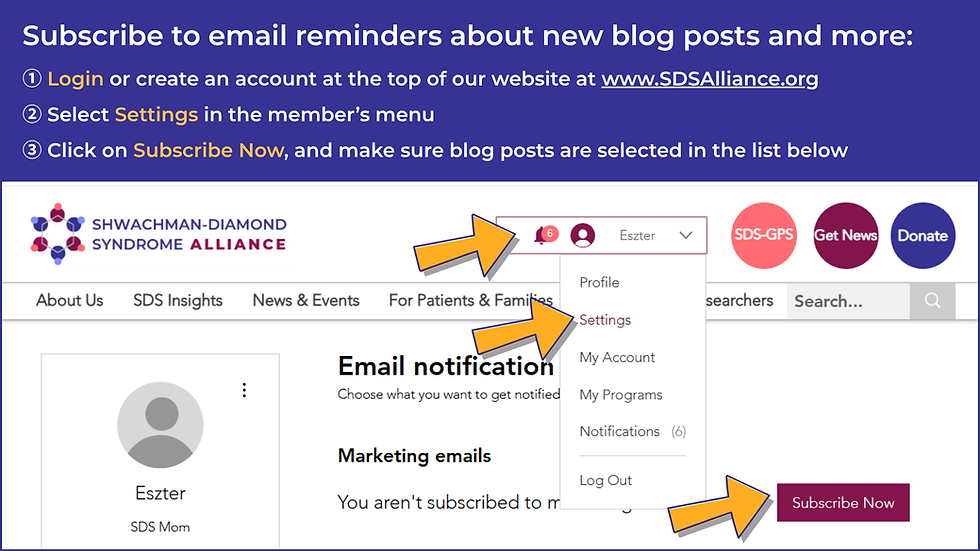
Subscribe to our blog to get email reminders about new posts!
① Login or create an account at the top of this website
② Select Settings in the member’s menu
③ Click on Subscribe Now, and make sure blog posts are selected in the list below


Comments