
Your Data, Reaching Further SDS-GPS Joins RDCA-DAP by C-Path

Your Data, Working Harder: SDS-GPS Joins RDCA-DAP
If you are participating in SDS-GPS, you've already taken an important step toward powering research and clinical trials that are being developed now. This month, that contribution of your lived experience just got bigger.
SDS-GPS data is now flowing into RDCA-DAP (the Rare Disease Cures Accelerator–Data and Analytics Platform), one of the largest integrated data platforms for rare disease research in the world. RDCA-DAP is run by Critical Path Institute (C-Path), a nonprofit that works with the FDA to help researchers design better clinical trials for rare diseases. Our research program, SDS-GPS, hosted on Matrix (built by Across Healthcare), now feeds de-identified SDS-GPS data into RDCA-DAP. This is a brand new integration, and we are excited to be part of the pilot program alongside two other rare disease communities.
This has been a long way coming, as we have been exploring collaboration opportunities with RDCA-DAP for several years. If you missed their introduction to our community at SDS POPS 2023, check it out here.
Why this matters
Rare disease research keeps running into the same problem: patients are hard to find, and their data is hard to align. Any single disease, including SDS, may only have a few hundred documented patients worldwide. That makes it nearly impossible for any one registry, or any one research team, to gather enough data on its own to answer the questions that matter most: how does SDS actually progress over time, and what should researchers measure to know if a treatment is working?
RDCA-DAP was developed to solve exactly that problem. It standardizes data from different sources such as registries, natural history studies, patient-reported data, survey data, and clinical trials, so researchers can study it together. Once SDS data is part of that system, researchers anywhere in the world can use it to study disease progression and help identify the kind of measurable endpoints that future SDS clinical trials will need.
This has always been the vision behind SDS-GPS. We don't just want to collect data, but build the infrastructure to share it responsibly, so that the information you contribute can go further and help drive real progress toward treatments, including the gene therapies and other approaches our community desperately needs.
Rare disease research keeps running into the same problem: patients are hard to find, and their data is hard to align. At SDS Alliance, we've always wanted to close that gap while building the infrastructure to pool data with others, so SDS patients' contributions can go further, faster. — Eszter Hars, Ph.D., CEO of SDS Alliance
What this means for you
You don't need to change anything on your end. You can continue using SDS-GPS as you have so far. As always, none of your personal information is ever shared. Only de-identified data, meaning nothing that identifies you personally, moves into RDCA-DAP. If you'd like more detail on how your data is protected in SDS-GPS, check out our recent blog about data privacy here: Your Data Is Safe: SDS-GPS Privacy.
What does change is the reach of what you have or will contribute. Data that once lived only in our registry is now part of a shared research infrastructure, alongside data from other rare disease communities, to turn patients' and families' lived experience into treatments.
What we're working on next
This integration is a meaningful step, but other challenges in the rare disease field remain: how do we connect the same patient's data across multiple, separate datasets, without sharing or exchanging identifying information?
We're pursuing collaborations with other SDS data holders, and exploring privacy-preserving approaches that would let researchers analyze data across multiple datasets and across multiple time points, without ever seeing who any of it belongs to. Options include shared identifier systems already used elsewhere in rare disease research, like NIH's Global Unique Identifier (GUID) or the newer Clinical Research ID (CRID), as well as third-party tokenization tools, like those offered by Datavant, that are built specifically for this purpose in health data.
SDS Alliance is committed to addressing the infrastructure gaps in order to accelerate therapy development for SDS - to give our families more birthdays to celebrate.
If you're a researcher, data holder, or organization interested in exploring this work with us, we'd love to hear from you. Reach out at gps@sdsalliance.org.
Haven't joined SDS-GPS yet?
If quality-of-life data that reflect what SDS actually looks like day-to-day, or our upcoming survey on patients' perspectives on gene therapy, weren't reason enough, here's one more: joining now allows your data to be part of an international research infrastructure that helps move treatments forward, while safeguarding your privacy.
Joining is free. It takes about 30-60 minutes to fill out the baseline surveys, and you can take breaks anytime. All you need is a device with internet access. If you have your genetics report available, please consider uploading it when prompted. No medical knowledge required. Make your voice count.
Questions about this survey or SDS-GPS? Visit the information page at www.sdsalliance.org/sds-gps or contact us at gps@sdsalliance.org.
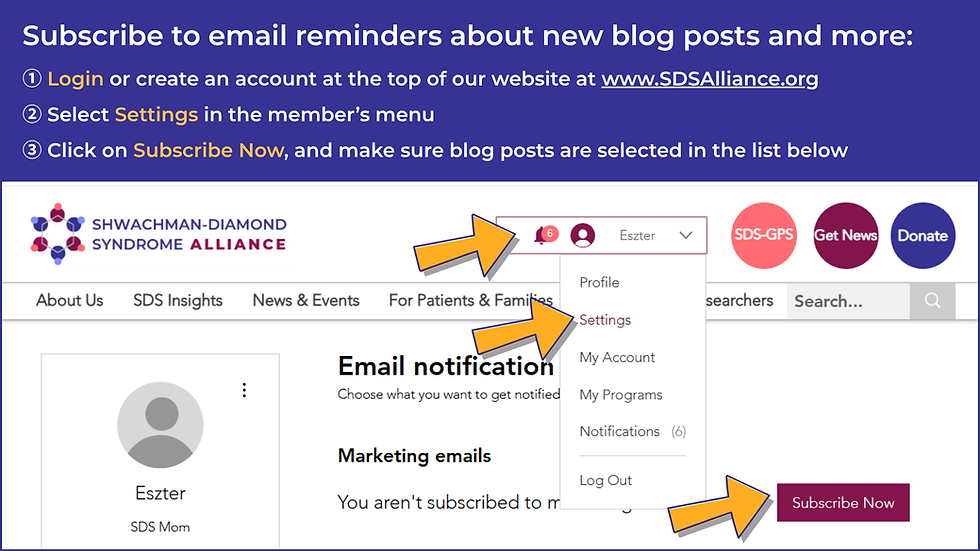
Subscribe to our blog to get email reminders about new posts!
① Login or create an account at the top of this website
② Select Settings in the member’s menu
③ Click on Subscribe Now, and make sure blog posts are selected in the list below


Comments