
The SDS PACER Course Is Now Live! Deep Dive into SDS, Research, and How You Can Make a Difference
Welcome to SDS Spotlight — our monthly series where Eszter shares a quick update on what we're working on, what we're excited about, and how YOU can get involved. Each month features a short video and a deeper dive right here on the blog.
If you live with Shwachman-Diamond Syndrome (SDS) or care for someone who does, you already know more about life with SDS than you think.
You know what it feels like to wait for a bone marrow result. You know the exhaustion of explaining SDS to yet another doctor who has never seen it before. You know which questions keep you up at night, and which ones still don't have good answers.
Researchers need to hear your insights. It is not just a "nice to have." It is a critical requirement for research and therapy development that actually helps people and families like you and me. This true partnership works best when we speak the same language — when we agree on the basic concepts and feel comfortable discussing them frankly.
That is why we built the SDS PACER Course.
What Is the SDS PACER Course?
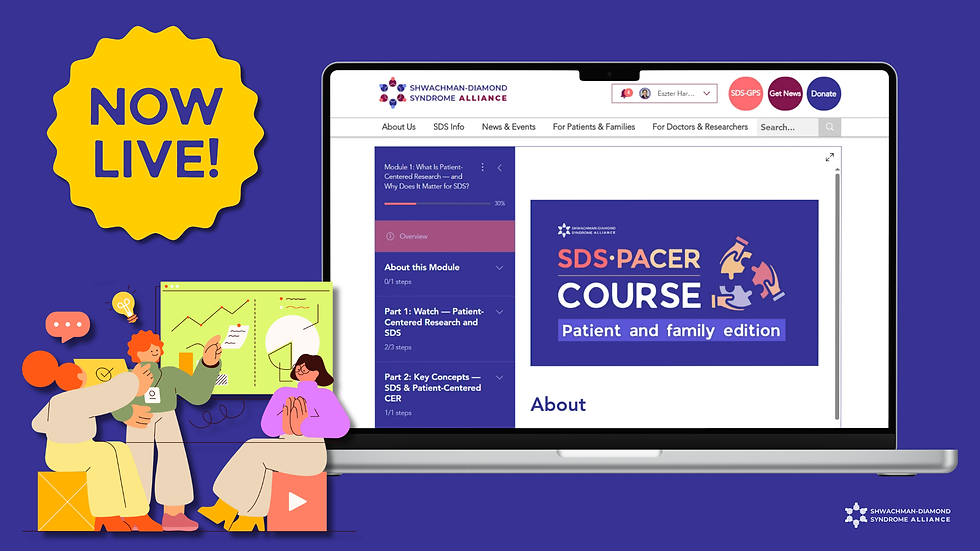
The SDS PACER Course — Patient and Family Edition is a free, self-paced online learning series built specifically for the Shwachman-Diamond Syndrome community. Its six modules are designed to help you understand the science behind SDS well enough to participate meaningfully in discussions, research, research prioritization and design, advocacy, and the decisions around your own or your family's care.
It is available now at www.sdsalliance.org/courses
. Create a free account on the SDS Alliance website and log in at the top of the page, then go to My Programs. Start whenever you are ready, at your own pace, on any device.
What You Will Learn
The six modules build on each other, from the foundations of patient-centered research to the frontier of SDS therapy development:
Module 1 — What Is Patient-Centered Research and Why Does It Matter for SDS? What patient-centered comparative effectiveness research is, how it differs from other kinds of research, and what your role in it can look like — anchored by a presentation from our collaborator Dr. Vanessa Merker of Massachusetts General Hospital and Harvard Medical School.
Module 2 — Genes, Proteins, and the SBDS Gene The genetics of SDS in plain language — what genes do, what variants are, how SBDS mutations cause SDS, and what that means for diagnosis, inheritance, and research.
Module 3 — Ribosomes, SBDS, and How SDS Affects the Body Why SDS affects so many different organ systems, what ribosomal stress means, and why every patient's experience is different.
Module 4 — Clonal Hematopoiesis, Leukemia Risk, and the Future of Treatment What happens in the bone marrow over time in SDS, how researchers are learning to predict leukemia risk, and what that means for surveillance decisions and emerging therapies.
Module 5 — Clinical Research and Therapy Development: How Treatments Reach Patients The full arc of drug development — from pre-clinical research through clinical trials and regulatory approval — and the many ways patients and organizations can shape that process.
Module 6 — Stem Cell Transplant and Gene Therapy: What's Available Now and Where We Are Headed (coming next week) What HSCT is, how donor matching works, how bone marrow surveillance tools work, and the three gene therapy approaches being developed specifically for SDS — including why gene editing is a better fit than traditional gene therapy.
Each module includes videos, written content, and a short quiz. You earn a badge and a certificate for each one you complete.
What Will I Get Out of the Course?
After completing the course, you will be equipped to make a real difference in many settings:
At the doctor: Speak up more clearly and confidently for yourself or your child
With researchers: Help scientists design better SDS studies with your informed perspective
In the community: Help and teach other SDS families — especially the newly diagnosed
In clinical trials: Make decisions about participation with real confidence
On advisory boards: Provide an informed patient perspective on research planning
With SDS Alliance: Participate in projects and help shape what we build next
You do not need a science background. This course is written for people who have been living with SDS — not for researchers*. If you have been managing this condition, or supporting someone who has, you already have the experience. The course gives you the framework to use it.
*A course dedicated to clinicians and researchers is coming soon.
Built for the Community, With the Community
This course was developed through Project PACER — SDS Alliance's two-year initiative funded by the Patient-Centered Outcomes Research Institute (PCORI) to build capacity for patient-centered research in Shwachman-Diamond Syndrome.
Our community survey shaped the content by asking what topics matter most to you. Our co-developers — patients and caregivers who test-drove the course and provided thoughtful feedback — helped us clarify and improve the content and . They include adult patients, caregivers of children at every stage of the SDS journey, spanning three continents.
When you take the course, you benefit from their work — and have the opportunity to help improve it further.
Our goal is clinical trials by 2030. An informed, research-ready community is a critical piece of the puzzle. The course is how we build that together.
Frequently Asked Questions
Is the course free?
Yes. The SDS PACER Course is completely free for all SDS community members worldwide.
Do I need a science background?
No. The course is written for patients and families, not scientists. Plain language throughout.
How long does it take?
Each module takes approximately 30–60 minutes. You can take breaks and continue anytime — the course saves your progress automatically.
Who can take the course?
Anyone in the SDS community — patients, caregivers, parents, partners, and family members. An edition for clinicians and researchers is coming soon.
Is it available in other languages?
The course is currently available in English. We are exploring additional languages as funding allows.
What do I get when I finish?
A badge and certificate for each completed module, and a full course certificate when all six are done.
Take the SDS PACER Course
Free, self-paced, open to the SDS community worldwide.
Create a free account or log in, go to My Programs, and begin with Module 1. Each module takes 30–60 minutes. You can take breaks and continue anytime.
Questions or comments? Email us at pacer@sdsalliance.org.
All October Resources at a Glance
🎓 Take the new SDS PACER course: www.sdsalliance.org/courses
🧬 New to SDS-GPS? Join here: www.sdsalliance.org/sds-gps-join
🧬 Existing SDS-GPS users, log in and complete your surveys at www.sdsalliance.org/sds-gps-login
🔬 St. Jude GeneTX study + SDS Alliance gene therapy survey: full details at https://www.sdsalliance.org/post/sds-gene-therapy-perspectives-survey
📅 SDS Action Week: November 1–7, 2026.
📞 SDS Family Network Welcome Call: Check the SDS Alliance Family Network (Facebook group) or email connect@sdsalliance.org
Questions? Contact us anytime at connect@sdsalliance.org
Project PACER is funded by the Patient-Centered Outcomes Research Institute (PCORI), Engagement Award EASO-42419.
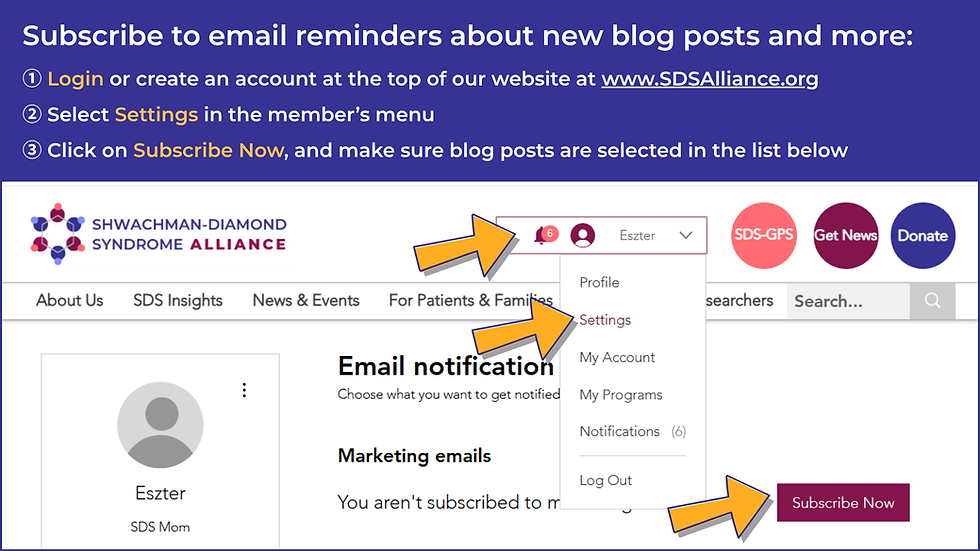
Subscribe to our blog to get email reminders about new posts!
① Login or create an account at the top of this website
② Select Settings in the member’s menu
③ Click on Subscribe Now, and make sure blog posts are selected in the list below


Comments